Venus — The Hottest Planet
Venus is the hottest planet in our solar system — even hotter than Mercury, which is closer to the Sun! Venus is wrapped in thick clouds that trap heat, and it spins backwards. It is a strange and amazing world.
Meet Venus, Our Cloudy Neighbour
Venus is the second planet from the Sun. It is 108.2 million kilometres away from the Sun — about twice as far as Mercury, but still much closer than Earth. Venus is almost the same size as Earth. It is 12,104 kilometres wide, while Earth is 12,756 kilometres wide. That is why people sometimes call Venus Earth's twin. But do not be fooled: Venus is nothing like Earth to live on!
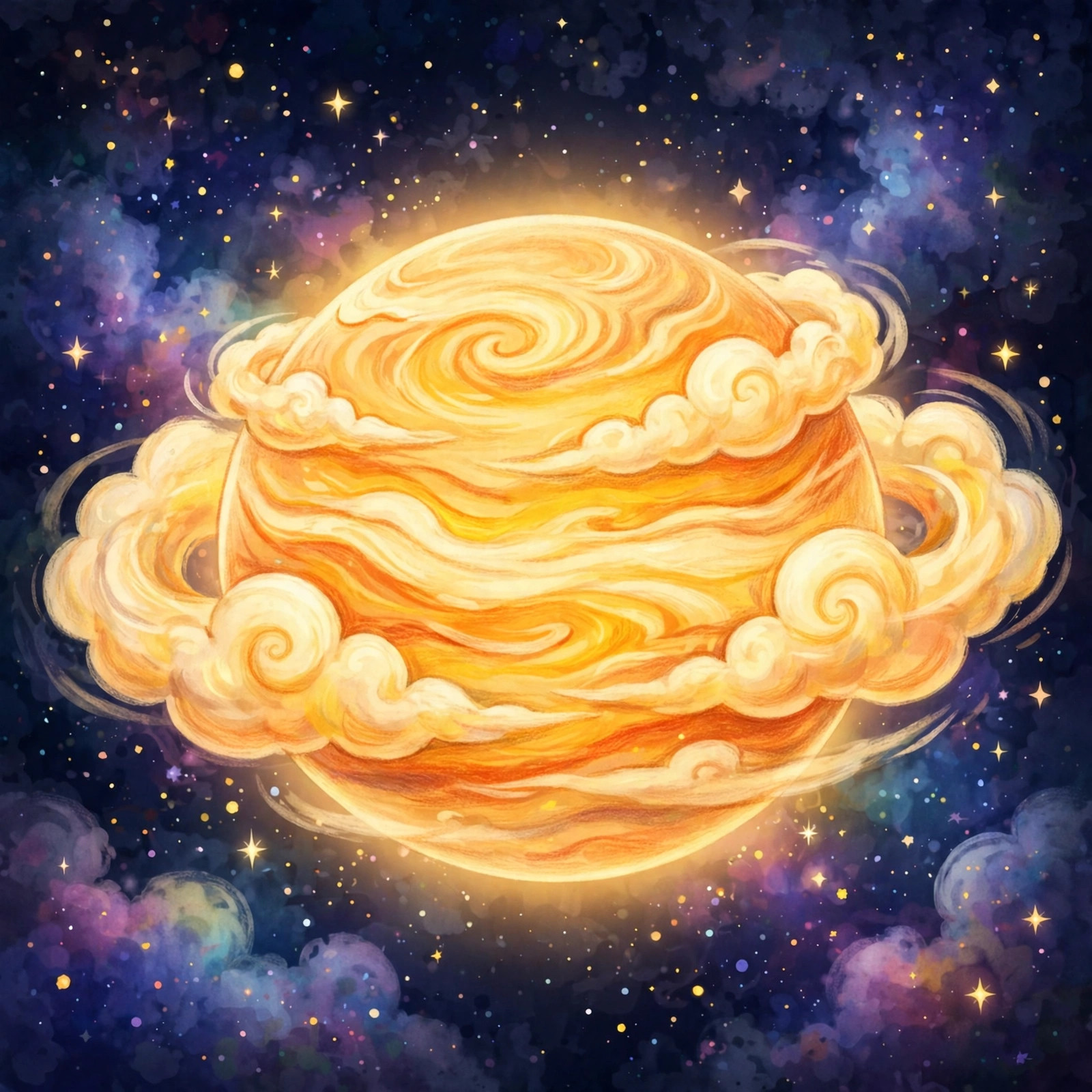
From space, Venus looks smooth and creamy yellow. You cannot see its ground at all, because it is covered in thick clouds. Those clouds never go away. They wrap the whole planet like a blanket, all day and all night.
Venus has no moons. As of 2026, scientists have confirmed 0 moons for Venus. It travels around the Sun alone, just like Mercury.
Why Is Venus So Hot?
Here is the big mystery: Mercury is closer to the Sun, so why is Venus hotter? The answer is in the air. Venus has a very thick atmosphere made mostly of a gas called carbon dioxide. That thick air traps the Sun's heat and will not let it escape back into space.
Think of a car parked in the Sun with the windows closed. The Sun shines in, the car gets hot, and the heat cannot get out. Venus works the same way, but much bigger and much stronger. The heat just builds up and builds up.
The result is amazing: the average temperature on Venus is 464 °C. That is hot enough to melt lead! It is hot all over the planet, day and night, because the thick clouds spread the heat everywhere. Even the dark side of Venus, away from the Sun, stays super hot.
The Planet That Spins Backwards
Most planets spin the same way they travel around the Sun. Venus does not! Venus spins backwards. If you could watch it from above, you would see it turning the opposite way from Earth and most of the other planets.
Venus is also the slowest spinner of all the planets. One spin takes 243 Earth days. That is longer than a whole year on Venus! A year on Venus — one full trip around the Sun — takes 224.7 Earth days. So a day on Venus (one spin) is longer than its year. How strange is that?
Because it spins so slowly, a full day on Venus — from one sunrise to the next sunrise — lasts 117 Earth days. Imagine waiting that long for the morning to come! And when the Sun does rise on Venus, it would rise in the west and set in the east, because the planet spins backwards.
Venus in Numbers
| How wide is it? | 12,104 km across — almost as big as Earth |
|---|---|
| How far from the Sun? | 108.2 million km (0.72 AU) |
| How long is a year? | 224.7 Earth days |
| How long is one spin? | 243 Earth days, backwards |
| How long is a full day? | 117 Earth days, from sunrise to sunrise |
| How many moons? | 0 moons, as of 2026 |
| Average temperature | 464 °C — the hottest planet |
| What is its air made of? | Mostly carbon dioxide, very thick clouds |
Could Anyone Live on Venus?
No way! Venus is one of the most unfriendly places in the solar system. The air is so thick that it would crush you, like being deep under the sea. No person could walk on Venus without a super-strong space suit.
Still, scientists love studying Venus. It teaches us what can happen when a planet's air traps too much heat. Earth has a little bit of carbon dioxide in its air too, and learning about Venus helps us understand why we must look after our own planet's air.
Watch and Learn About Venus
Want to see Venus and its rocky planet neighbours in action? These two videos are a great place to start.
Watch: Explore the Solar System: The Rocky Planets (SciShow Kids)
Watch: Solar System 101 (National Geographic)
