The Sun: Our Amazing Star
Every morning, the Sun rises and lights up our whole world. But did you know the Sun is actually a star? It is the closest star to Earth — and the most important thing in our solar system. Without it, there would be no light, no warmth, and no life on Earth at all.
What Is the Sun?
The Sun is a yellow dwarf star — a hot, glowing ball of gas made mostly of hydrogen and helium. It is held together by its own gravity, the same force that keeps your feet on the ground. Inside the Sun, hydrogen turns into helium, and that process creates the energy that makes the Sun shine. That energy travels all the way to Earth as light and heat.
The Sun is the boss of our solar system. It holds 99.86% of all the mass in the solar system. That means almost everything in our neighbourhood in space is the Sun itself! All eight planets, the Moon, and every asteroid and comet together make up less than 1% of what is left. The Sun's gravity is so strong that it keeps all the planets travelling around it in circles, like a giant invisible rope.
How Big Is the Sun?
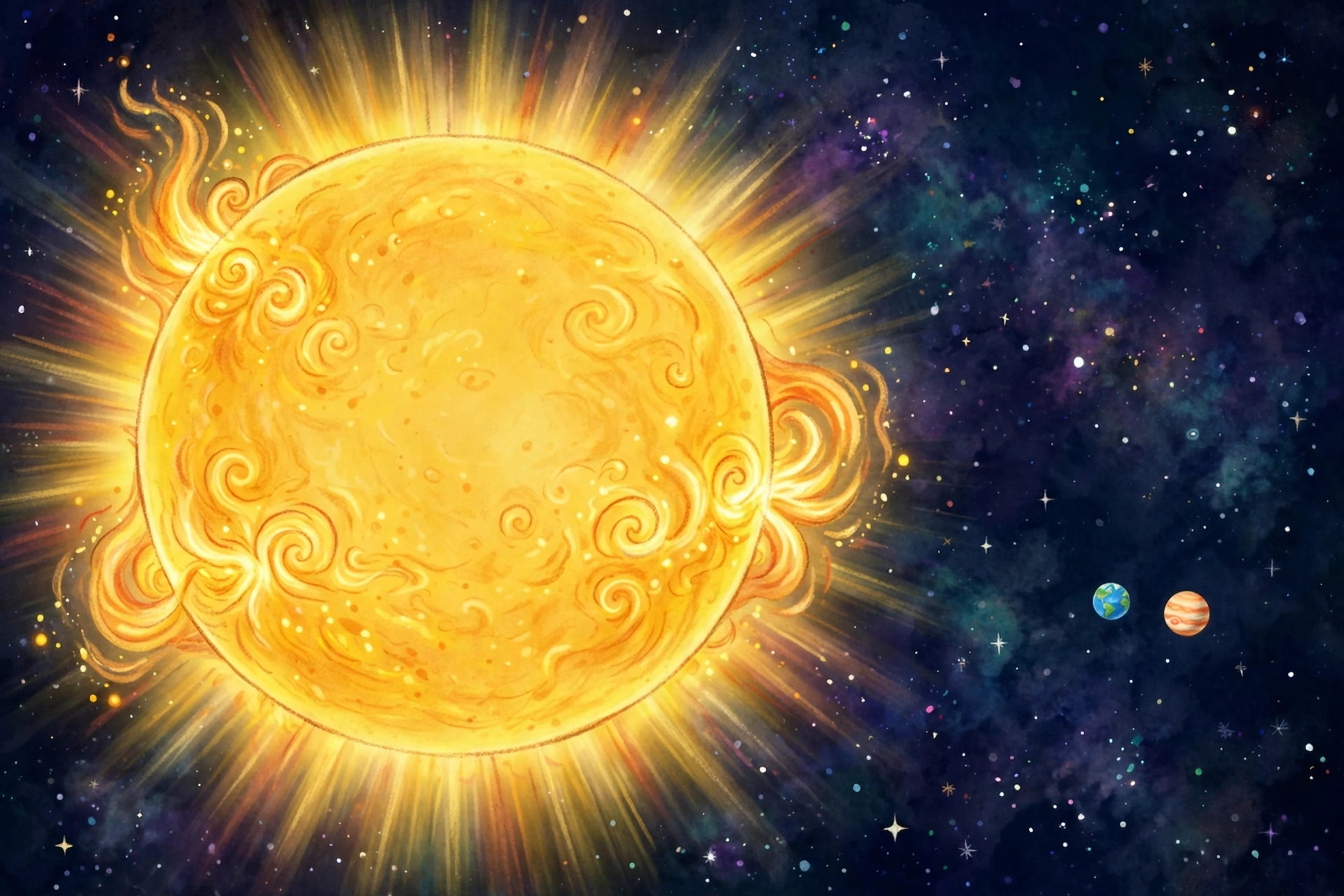
The Sun is huge. Really huge. Its diameter — the distance straight across its middle — is 1,392,000 kilometres. That makes it 109 times wider than Earth. If the Sun were a giant beach ball, Earth would be smaller than a marble next to it.
Sun Facts at a Glance
| Diameter | 1,392,000 km — 109 times wider than Earth |
|---|---|
| Surface temperature | 5,500 °C |
| Core temperature | 15,000,000 °C |
| Age | About 4.5 billion years old |
| Share of solar-system mass | 99.86% |
| Distance from Earth | About 150 million km |
| Sunlight travel time | About 8 minutes and 20 seconds to reach Earth |
| What it is | A yellow dwarf star, made mostly of hydrogen and helium |
| Earths that fit inside | About 1.3 million |
How Hot Is the Sun?
The Sun is the hottest thing you will ever learn about. Its surface is about 5,500 °C. That is more than 50 times hotter than boiling water! But the surface is the cool part. Deep inside, in the Sun's core, the temperature reaches about 15,000,000 °C. Nothing on Earth is anywhere near that hot.
Luckily, the Sun is about 150 million kilometres away from us. That is far enough that we get just the right amount of warmth. If Earth were much closer, like Mercury, it would be far too hot for life. If Earth were much farther away, like Neptune, it would be freezing cold. Earth sits in a just-right spot, which scientists sometimes call the Goldilocks zone — not too hot, not too cold, just right for us.
How Old Is the Sun?
The Sun is about 4.5 billion years old. That is older than Earth itself, and far older than any dinosaur, mountain, or ocean on our planet. Scientists think the Sun is about halfway through its life. It has around 5 billion more years of shining left before it slowly changes into a different kind of star.
Think about it this way: if the Sun's whole life were one day, humans have only been around for the last few seconds before midnight. The Sun has been shining for a very, very long time — and it will keep shining for a very, very long time to come.
How Far Away Is the Sun?
The Sun is about 150 million kilometres from Earth. If you could drive there in a car at motorway speed, it would take you more than 170 years — and you would have to drive non-stop, day and night, without ever sleeping! Light is much faster. Sunlight takes only about 8 minutes and 20 seconds to reach us. That means the sunlight warming your face right now left the Sun about eight minutes ago.
Here is a fun thought: when you look at the Sun (never look straight at it — it can hurt your eyes!), you are seeing it as it was eight minutes in the past. You are a time traveller every time you look up at the sky!
Watch and Learn
Want to see the Sun up close? Watch these two videos. The first is a quick tour of our star from National Geographic. The second, from SciShow Kids, answers the big question: what are stars, anyway?
Watch: Sun 101 | National Geographic (National Geographic)
Watch: What Are Stars? (SciShow Kids)
