🌌 Galaxies & Black Holes
Our Sun is just one star among hundreds of billions. All those stars, together with gas, dust and planets, form a giant family called a galaxy. And at the very centre of our galaxy hides something strange and amazing: a black hole.
What Is a Galaxy?
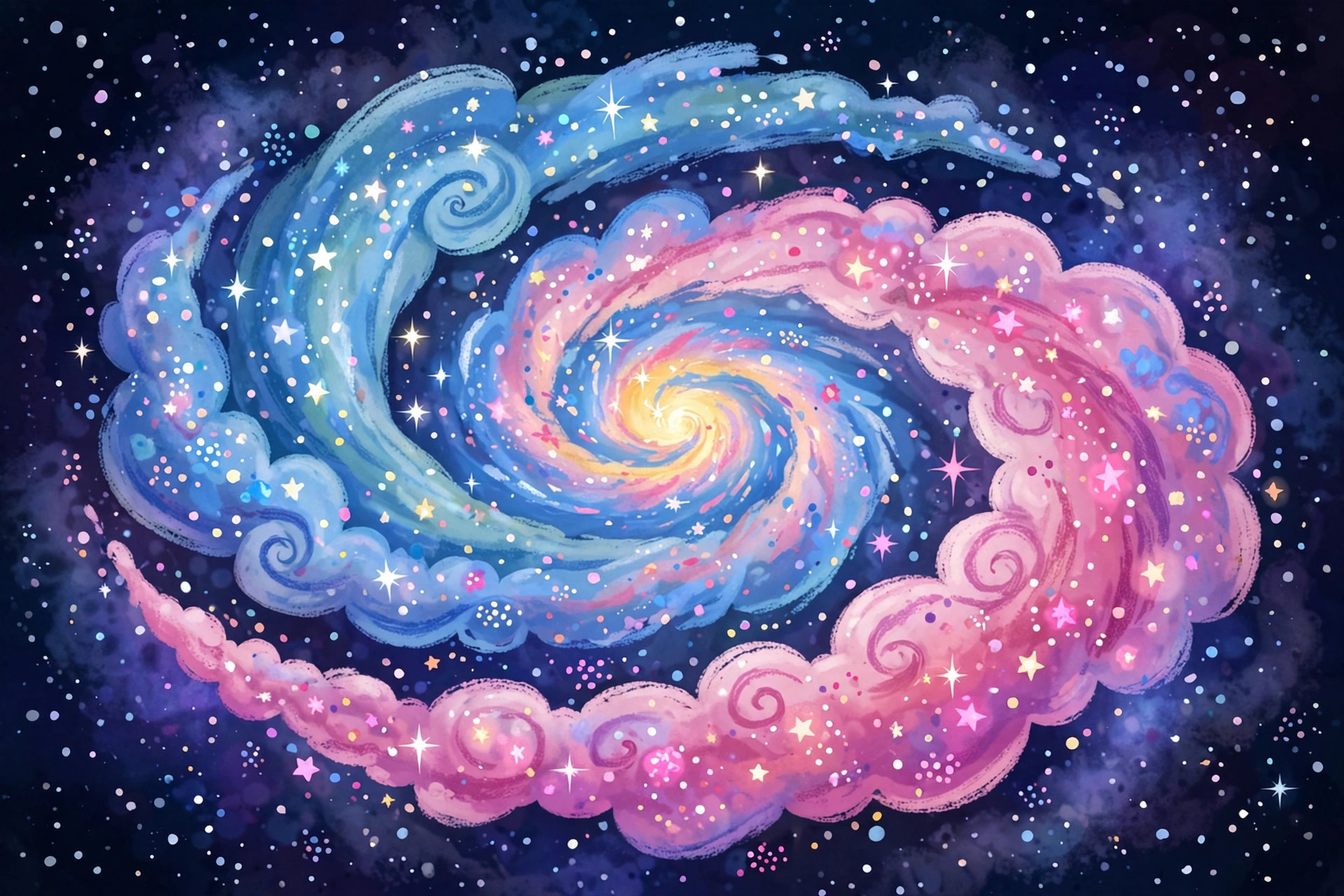
A galaxy is a huge group of stars, plus gas, dust and planets, all held together by gravity. Think of it as a really, really, really big group of stars, and their planets, all hanging out together in space. Gravity is the invisible glue that keeps the whole family together.
Galaxies come in different shapes. Some are spirals, like a giant pinwheel spinning slowly in space. Some are round like a ball. Others look messy and have no clear shape at all. But every galaxy is huge. Even a small galaxy holds millions of stars.
There are far more galaxies in the universe than we can count. Each one is like an island of stars floating in the dark sea of space. And our own galaxy is one of them.
Our Home Galaxy: The Milky Way
We live in a galaxy called the Milky Way. On a dark night, far away from city lights, you can see it as a pale, milky band of light stretching across the sky. That band is the light of billions of stars, all packed together so tightly that our eyes cannot see them one by one.
The Milky Way is a barred spiral galaxy. That means it has long arms that curl out from a bar-shaped centre, like a spinning pinwheel. Our Sun sits near the edge of the spiral, about 28,000 light-years from the centre. It takes light 28,000 years to travel from the centre of our galaxy all the way out to us!
How big is the Milky Way? It is about 100,000 light-years across. Imagine a beam of light racing at top speed. It would need 100,000 years just to cross from one side of our galaxy to the other. And how many stars live inside it? Scientists think the Milky Way holds probably 100 to 400 billion stars. That is more stars than there are grains of sand on all the beaches of Earth.
| What is a galaxy? | A huge group of stars (plus gas, dust and planets) held together by gravity |
|---|---|
| Our galaxy | The Milky Way — a barred spiral galaxy |
| Stars in the Milky Way | Probably 100 to 400 billion stars |
| Size of the Milky Way | About 100,000 light-years across |
| Where is our Sun? | Near the edge of the spiral, about 28,000 light-years from the centre |
| What is a black hole? | An area of such immense gravity that nothing — not even light — can escape from it |
| Sagittarius A* | The supermassive black hole at the centre of the Milky Way, about 4 million times the mass of our Sun, about 28,000 light-years away |
What Is a Black Hole?
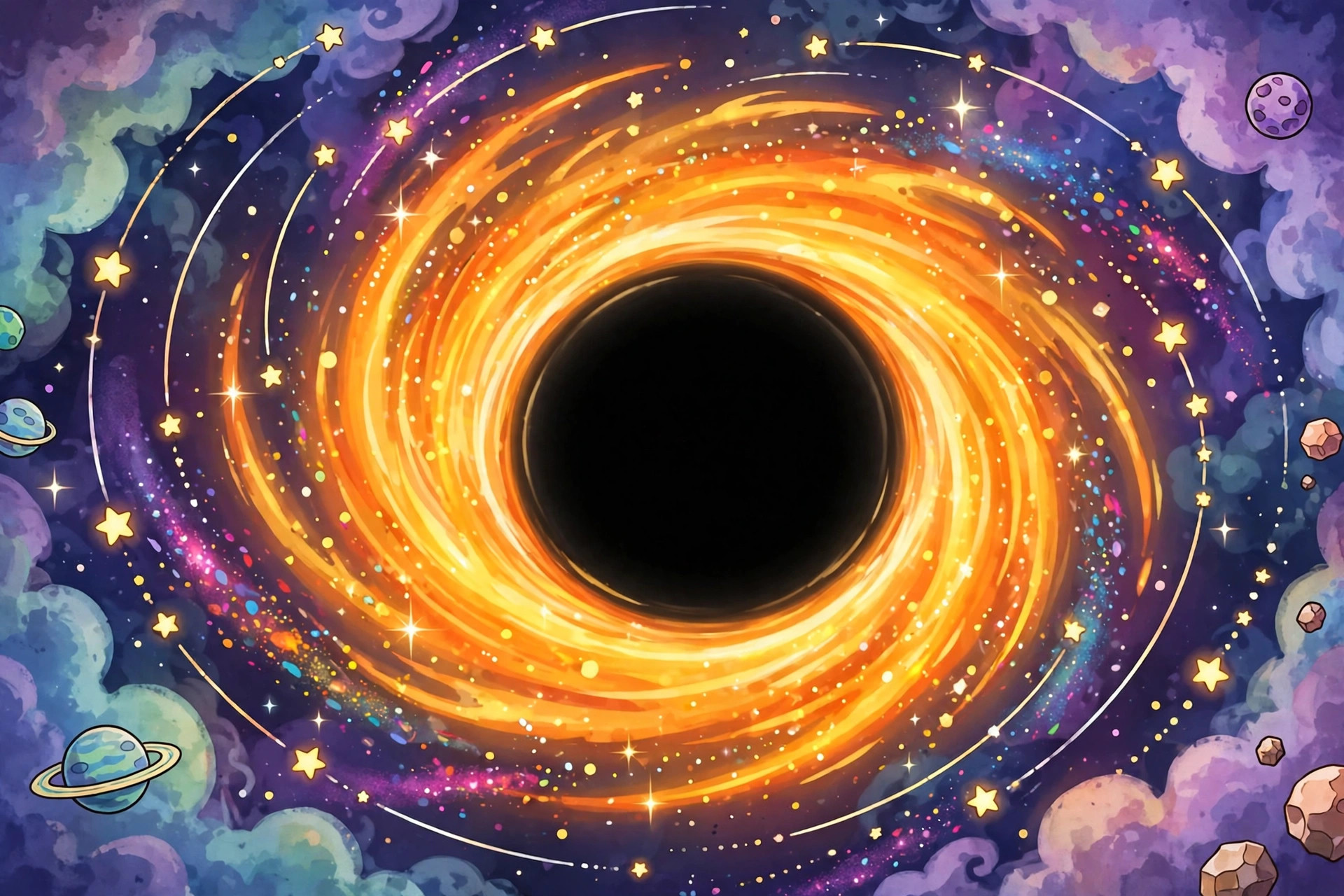
A black hole is an area of space where gravity is so strong that nothing can escape from it — not even light. Light is the fastest thing in the universe, and even light cannot climb out of a black hole. That is why black holes look black. No light comes out for us to see.
How does a black hole form? Black holes form at the end of some stars' lives, when a very big star collapses in on itself. The star's material gets squeezed into a tiny, tiny space, and gravity becomes so powerful that it traps everything nearby.
Do not worry: a black hole is not a vacuum cleaner that sucks up the whole universe. Its gravity is very strong close up, but far away it acts just like the gravity of any other heavy object. You would have to get very close to a black hole to be in danger.
The Monster at the Centre of Our Galaxy
Right at the centre of the Milky Way sits a giant black hole called Sagittarius A*. It is a supermassive black hole, which means it is far bigger than the black holes left behind by single stars. Scientists think it weighs about 4 million times as much as our Sun.
Sagittarius A* is about 28,000 light-years away from Earth — the same distance as our Sun is from the centre of the galaxy, because the black hole is the centre. It is far too far away to hurt us. But it is busy: stars near the centre race around it at amazing speeds, pulled by its mighty gravity.
Scientists study Sagittarius A* to learn how galaxies grow. Many big galaxies seem to have a supermassive black hole at their heart. Our galaxy and its black hole grew up together, over billions of years.
Watch and Learn
Want to explore our galaxy? Watch these two fun videos from SciShow Kids. The first one asks what the Milky Way is, and the second takes you on a tour to get to know your galaxy. Both are full of big ideas explained in a simple way.
Watch: What Is the Milky Way? (SciShow Kids)
Watch: Get to Know Your Galaxy! | Astronomy for Kids (SciShow Kids)
You Live in a Galaxy!
Here is a thought to carry with you: you are not just living on a planet. You are living on a planet, going around a star, that is flying around the centre of a giant galaxy, along with hundreds of billions of other stars. And right at the middle of it all sits a black hole four million times heavier than our Sun.
On the next clear, dark night, look up and try to find the pale band of the Milky Way. Every bit of light in that band is a faraway sun. Somewhere among those stars, other planets are turning — and maybe, just maybe, someone else is looking back at our little corner of the galaxy.
