Earth — Our Home in Space
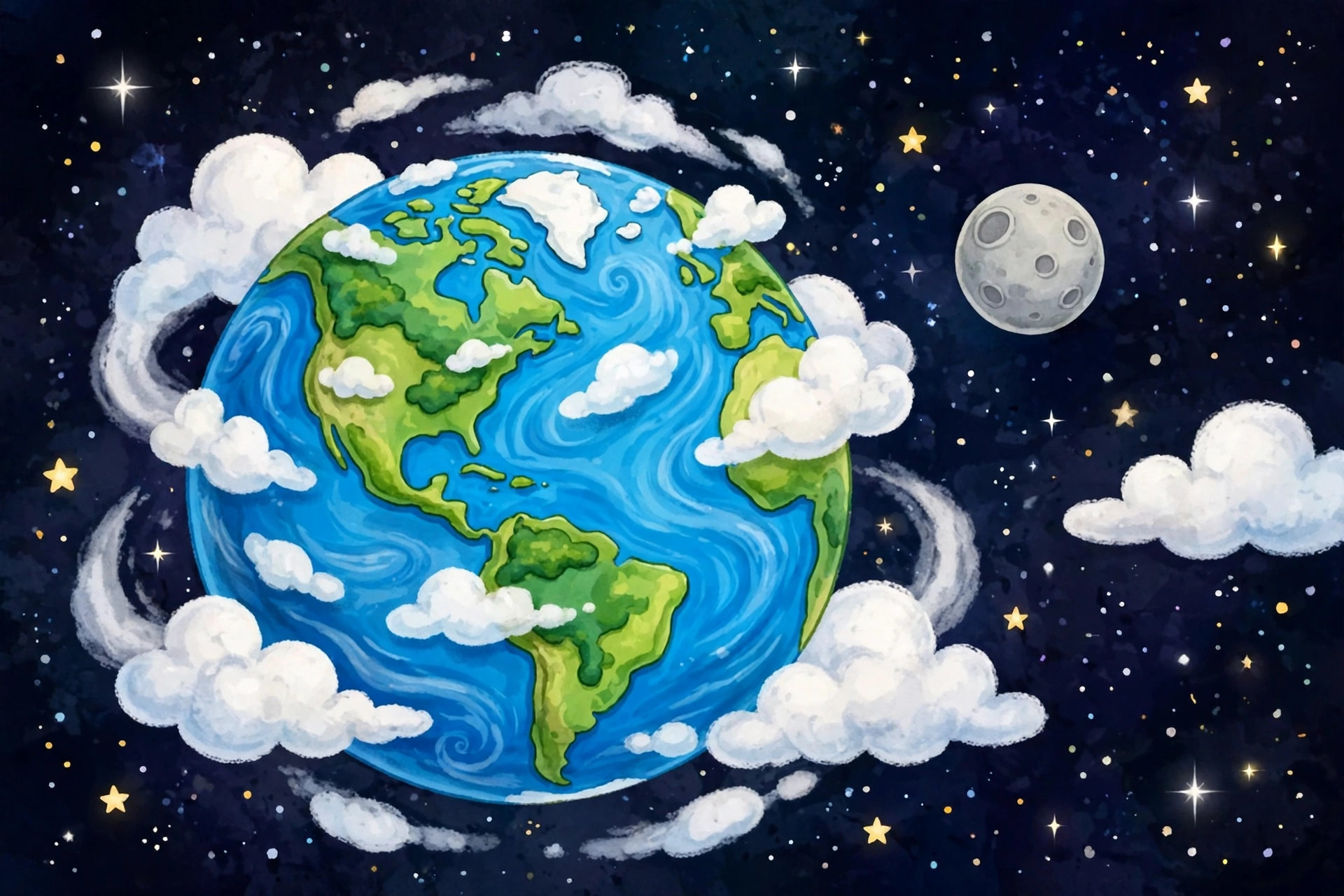
Earth is our home — and it is the only place in the whole universe known to have life! It is the third planet from the Sun, with blue oceans, green land, fresh air, and one Moon. No other planet we know is like it.
Meet Earth, the Blue Planet
Earth is the third planet from the Sun. It sits 149.6 million kilometres away from the Sun — not too close and not too far. That is just right! If Earth were much closer, it would be too hot. If it were much farther away, it would be too cold. This perfect spot helps water stay liquid, and that helps life grow.
Earth is 12,756 kilometres wide. From space it looks blue, because most of its surface is covered by oceans. The rest is land — continents, mountains, deserts and forests — where people, animals and plants live.
Earth has a blanket of air around it called the atmosphere. The air gives us the oxygen we breathe, and it keeps us warm enough to live.
One Day, One Year
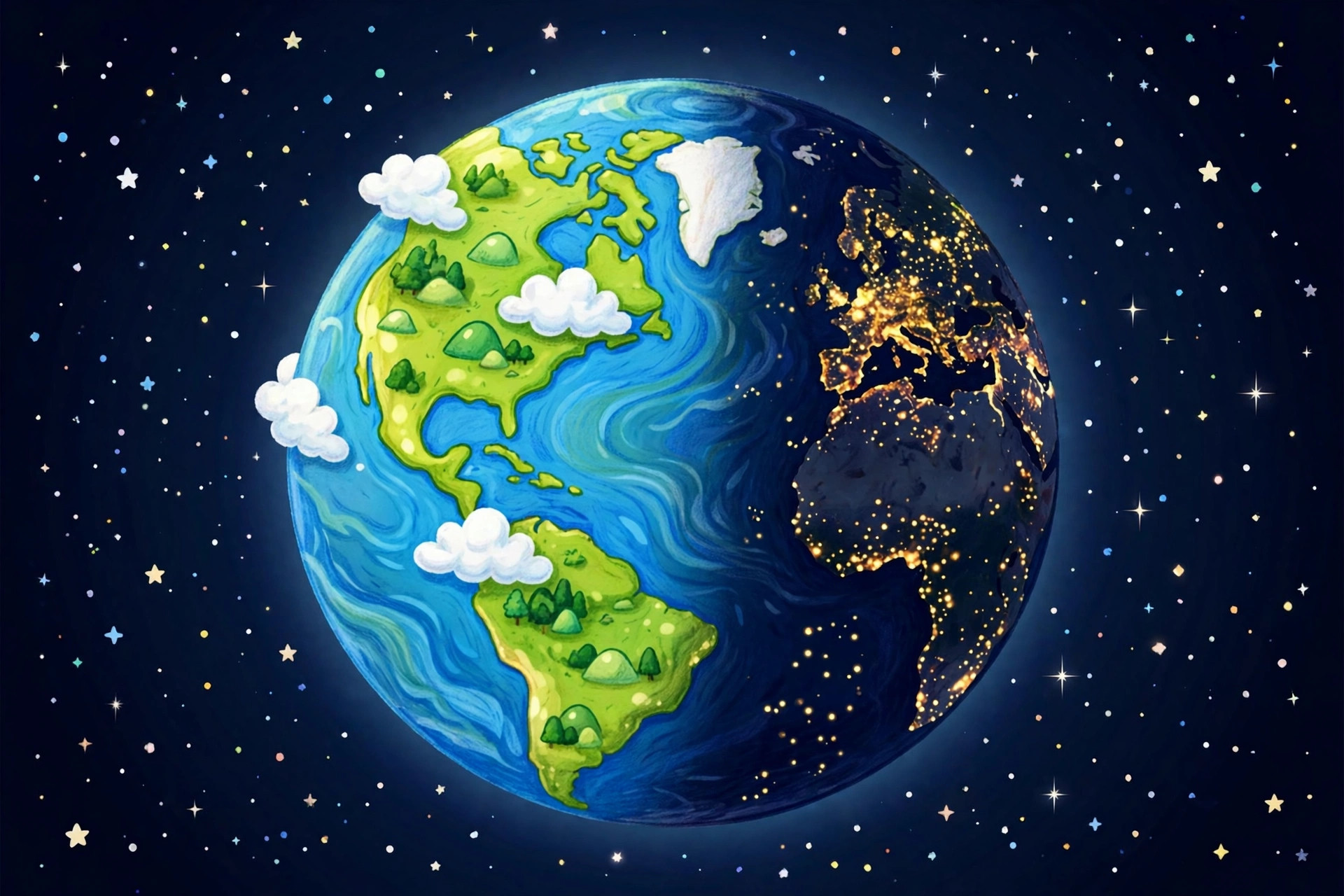
Earth spins like a top. One full spin takes 23.9 hours — we call that one day. As Earth spins, one side faces the Sun and has daytime, while the other side faces away and has night. That is why the Sun seems to rise in the morning and set in the evening.
At the same time, Earth is travelling around the Sun. One full trip — one year — takes 365.2 days. That is why our year has 365 days, with an extra day added every four years in a leap year to catch up with the extra bit.
Earth is also tilted as it travels. That tilt is what gives us seasons. When your part of Earth tilts towards the Sun, you get summer with long warm days. When it tilts away, you get winter with short cold days. Spring and autumn sit in between.
Earth's One and Only Moon
Earth has one Moon. As of 2026, scientists have confirmed 1 moon for Earth. Our Moon is 3,475 kilometres wide — about a quarter of Earth's width. It is 384,400 kilometres away from us on average. That sounds far, but in space it is close: about 30 Earths could fit in the gap between Earth and the Moon!
The Moon travels around Earth once every 27.3 days. It pulls on Earth's oceans and makes the tides — the sea going in and out at the beach. The Moon also lights up our night sky, and its changing shapes, called phases, have amazed people for thousands of years.
People have even visited the Moon! The first person to walk on it was Neil Armstrong, in 1969. You can read the whole story on our Moon page.
Earth in Numbers
| How wide is it? | 12,756 km across |
|---|---|
| How far from the Sun? | 149.6 million km (1.00 AU) |
| How long is a day? | 23.9 hours — one spin |
| How long is a year? | 365.2 Earth days |
| How many moons? | 1 moon, as of 2026 |
| Average temperature | 15 °C — just right for life |
| What makes it special? | The only place known to have life |
Why Earth Is So Special
Scientists have searched for other planets like Earth, but so far none of them looks just like our home. Earth has liquid water on its surface, air we can breathe, and a temperature that stays just right most of the time. Its average temperature is 15 °C — cool enough for ice at the poles and warm enough for rainforests at the equator.
Life is everywhere on Earth. It lives in the deepest oceans, on the tallest mountains, in hot deserts and in freezing snow. There are fish, birds, trees, insects, and of course people! All of us share this one planet, so looking after it is the most important job we have.
Earth is also our launch pad to the stars. Every rocket, every astronaut and every space mission starts here. When astronauts look back at Earth from space, they say it looks beautiful and fragile — a blue marble floating in the dark. That is a good reminder to take care of our home.
Watch and Learn About Earth
Want to see Earth and its rocky planet neighbours in action? These two videos are a great place to start.
Watch: Explore the Solar System: The Rocky Planets (SciShow Kids)
Watch: Solar System 101 (National Geographic)
