Neptune — The Coldest Planet
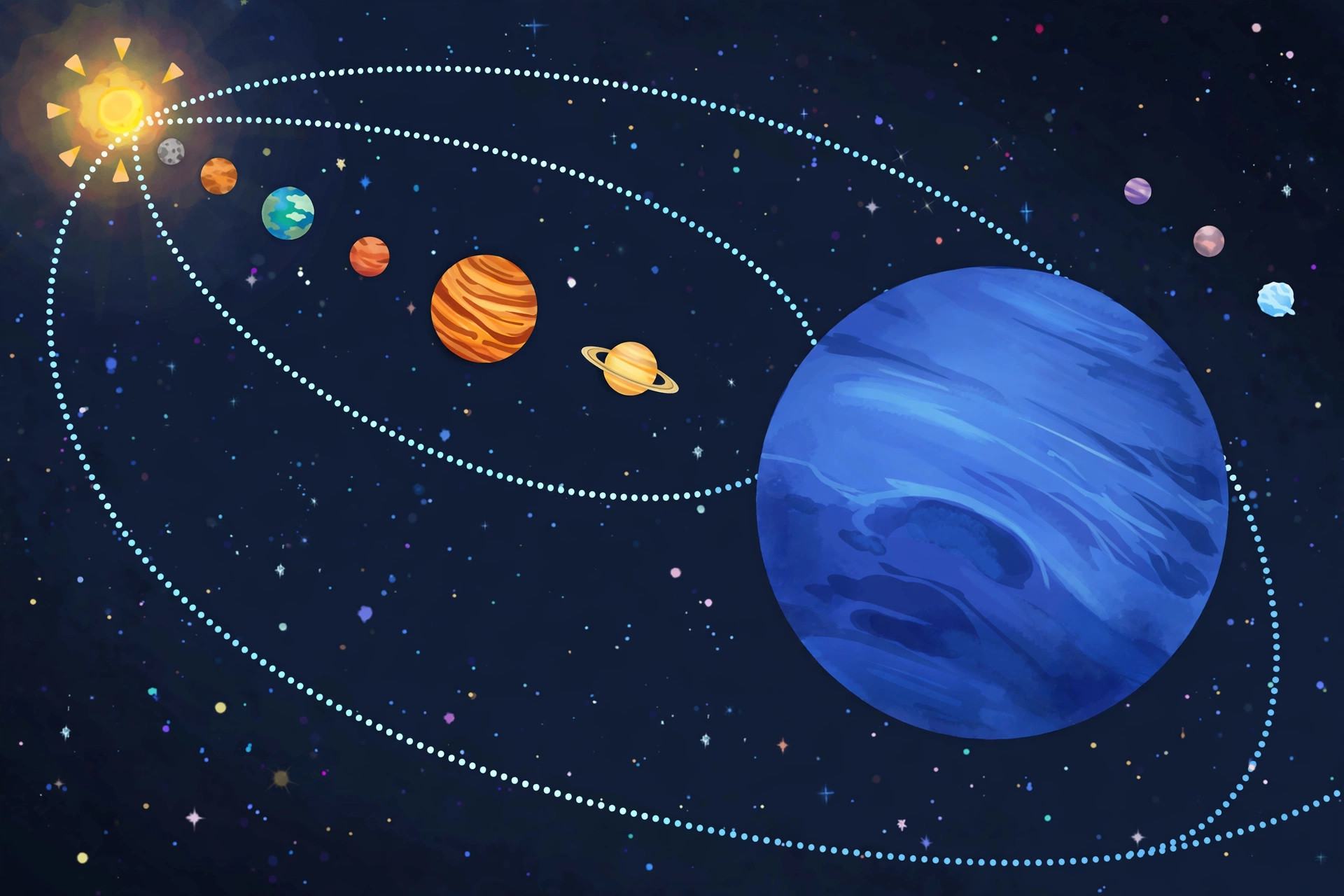
Neptune is the last planet in our solar system. It is the farthest planet from the Sun and the coldest planet of all. It is a deep blue world, floating in the dark at the very edge of the Sun's family.

The Last Planet
Neptune is the eighth planet from the Sun. There is no planet farther away. It sits 4,515 million kilometres from the Sun. That is about 30 times farther from the Sun than Earth is.
Think about how far that is. Sunlight takes about 8 minutes to reach Earth. It takes more than 4 hours to reach Neptune! From Neptune, the Sun looks like a small, bright star in the sky. It gives very little light and almost no warmth.
Neptune is a gas giant, like Jupiter, Saturn, and Uranus. Its diameter is 49,528 kilometres. That makes Neptune almost four times wider than Earth. It is the smallest of the four gas giants, but it is still a huge world.
A Deep Blue World
Neptune is a beautiful deep blue colour. Bright white clouds drift across its blue surface. Neptune is a cold, faraway world, spinning in the dark at the edge of the solar system.
Neptune is very hard to see from Earth. It is so far away that you cannot see it without a telescope. It is a tiny blue dot in the dark, even through a telescope.
The Coldest Planet
Neptune's average temperature is minus 200 degrees Celsius. That makes it the coldest planet in the solar system. It is even colder than Uranus, its neighbour. On Neptune, it is so cold that the air itself would freeze your breath in a blink.
Neptune is cold because it is so far from the Sun. The Sun's warmth barely reaches it. Neptune is a world of deep cold, deep blue, and strong storms, spinning in the dark far, far away.
A Very Long Year
Neptune spins quite fast. One day on Neptune — one full spin — takes only 16.1 hours. That is shorter than a day on Earth. But Neptune's year is the longest of all the planets. Neptune takes 163.7 Earth years to travel once around the Sun!
Think about that. A kid who is 12 years old on Earth would be less than one month old in Neptune years. Neptune moves very slowly because it has the longest journey of all — a giant circle around the Sun, far out in the dark.
Neptune's Moons
Neptune has 16 moons. They circle around the planet in the cold dark, far from the Sun. Neptune and its moons live at the very edge of the solar system, where the Sun is just a small bright star in the sky.
| Fact | Neptune |
|---|---|
| Diameter | 49,528 km — almost 4 times wider than Earth |
| Distance from the Sun | 4,515 million km (30.18 AU) |
| Length of day (one spin) | 16.1 hours |
| Length of year (one orbit) | 59,800 days (163.7 Earth years) |
| Moons | 16 |
| Average temperature | −200 °C — the coldest planet |
| Planet type | Gas giant — the farthest planet from the Sun |
Watch and Learn
Want to see Neptune and its gas-giant friends up close? Watch these two videos. The first one takes you on a tour of the gas giants. The second one shows you the whole solar system.
Watch: Explore the Solar System: The Gas Giants (SciShow Kids)
Watch: Solar System 101 (National Geographic)
