Mars — The Red Planet
Mars is the red planet — a cold, dusty world with giant volcanoes, deep canyons, two tiny moons and robot rovers driving across its surface right now. It is the planet scientists dream of visiting next!
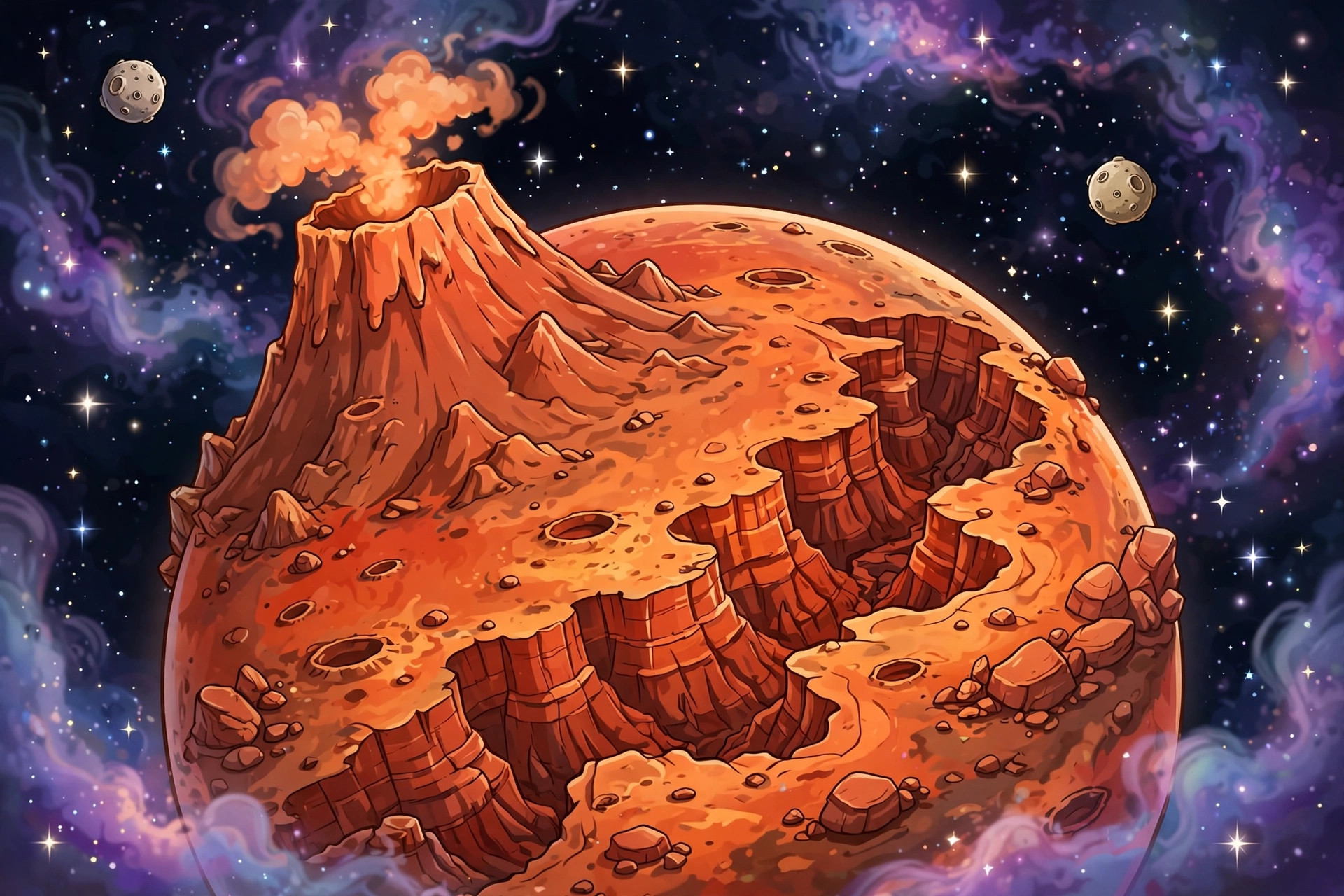
Meet Mars, the Red Planet
Mars is the fourth planet from the Sun. It is 228 million kilometres away from the Sun — about one and a half times farther than Earth. Mars is 6,792 kilometres wide, which is about half the width of Earth. It is the second-smallest planet, after Mercury.
Why is Mars red? The ground is covered in rusty red dust. The dust is made of iron, the same metal that makes an old bike go rusty. When the wind blows, the red dust flies into the sky and makes the whole planet look red, even from Earth. Long ago, people saw that red colour in the night sky and named the planet after Mars, the Roman god of war.
Mars looks a lot like a desert on Earth, but a very cold one. It has mountains, valleys, dry river beds and huge dust storms. Its sky is not blue like ours — it is a pale orange-pink colour, because of all that dust floating in the air.
A Day Like Ours, a Year Almost Twice as Long
A day on Mars feels almost like a day on Earth. One spin takes 24.6 hours — just a little bit longer than our 24-hour day. If you lived on Mars, your day would be only about 40 minutes longer than a day on Earth!
But a year on Mars is much longer. One full trip around the Sun takes 687 Earth days. That is almost two Earth years! So a kid living on Mars would have a birthday only about once every two Earth years.
Mars is cold. Its average temperature is −65 °C. That is far colder than the coldest winter day on Earth. Mars is cold because it is farther from the Sun than Earth, and because its air is very thin and cannot hold much heat. Even on a warm summer day at the equator, Mars is still freezing by our standards.
Mars Has Two Tiny Moons
Mars has two moons, and they are both small and oddly shaped — more like lumpy potatoes than round balls. As of 2026, scientists have confirmed 2 moons for Mars. Their names are Phobos and Deimos.
Phobos and Deimos are so small that they look like bright stars in the Martian sky, not like our big Moon. Scientists think they may be space rocks that were caught by Mars's gravity long ago, or pieces left over from a giant crash.
Mars has giant volcanoes and deep canyons. It is a cold, dry, dusty world — very different from Earth, even though the two planets are neighbours.
Mars in Numbers
| How wide is it? | 6,792 km across — about half of Earth |
|---|---|
| How far from the Sun? | 228 million km (1.52 AU) |
| How long is a day? | 24.6 hours — one spin |
| How long is a year? | 687 Earth days |
| How many moons? | 2 moons — Phobos and Deimos, as of 2026 |
| Average temperature | −65 °C — very cold |
| Why is it red? | Rusty red dust made of iron covers the ground |
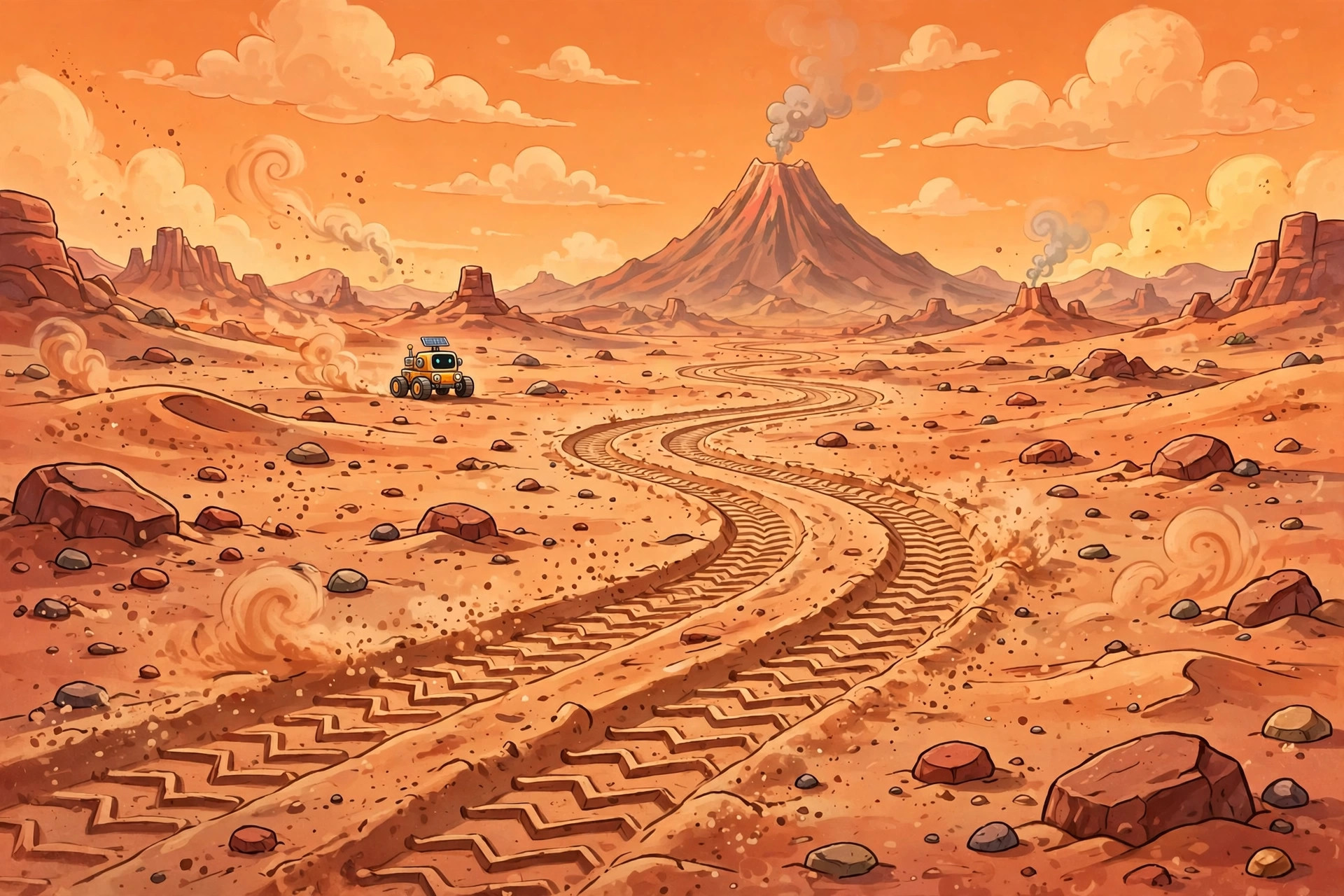
Robots Are Exploring Mars Right Now
No person has ever been to Mars — yet. But robots have! Space agencies have sent landers and rovers to Mars. A rover is a robot car with wheels, cameras and science tools. It drives across the ground, takes photos, and tests the rocks and dust.
The rovers have taken thousands of photos of craters, mountains and sunsets on Mars, and they test the rocks and dust to learn what the planet is made of. Many people hope that one day astronauts will travel to Mars and walk on its red dust. Maybe a kid reading this page right now will be one of them!
Watch and Learn About Mars
Want to see Mars and its rocky planet neighbours in action? These two videos are a great place to start — the second one meets the robot rovers!
Watch: Explore the Solar System: The Rocky Planets (SciShow Kids)
Watch: Meet the Mars Rovers! | Let's Explore Mars! (SciShow Kids)