🚀 Rockets & Astronauts
How do you fly when there is no air to push against? Rockets solve that puzzle with a clever trick — and they have carried brave astronauts to space, to the Moon, and to a giant home in the sky called the International Space Station.
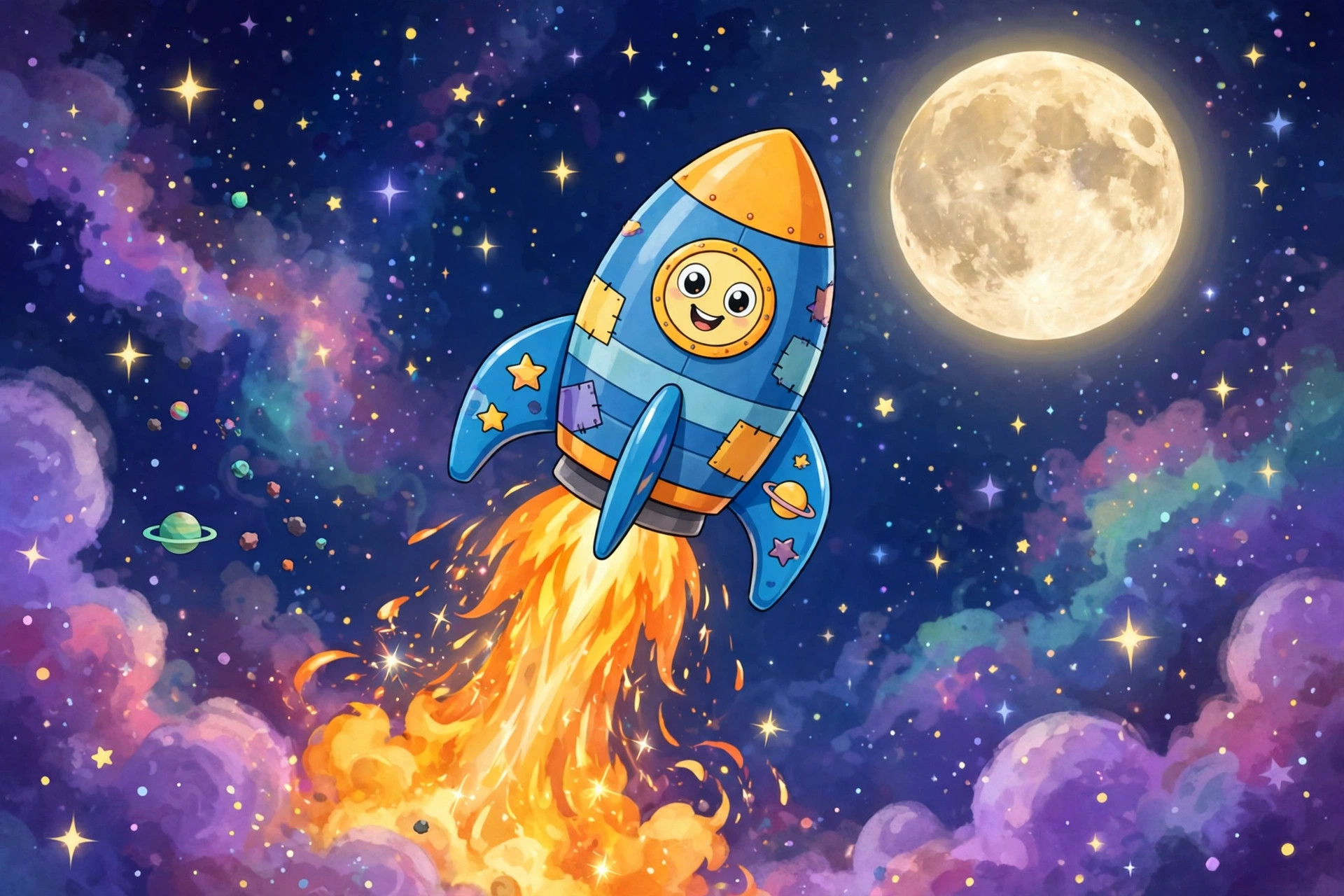
How Does a Rocket Fly?
A rocket is a chamber that holds gas under pressure. The gas escapes through a small opening called a nozzle, and it pushes the rocket the opposite way. It works just like letting go of a blown-up balloon. The air rushes out one way, and the balloon zooms off the other way.
In a real rocket, burning fuel makes the hot gas. The gas shoots out of the nozzle at the bottom, and the rocket is pushed up. This is Newton's third law in action: for every action, there is an equal and opposite reaction. Push gas down, and the rocket goes up.
Here is the clever part: a rocket carries its own oxygen, so it can make thrust in the vacuum of space, where there is no air. A jet plane needs air from outside to burn its fuel. A rocket brings everything it needs with it. That is why rockets work in space, where there is nothing to push against and no air to breathe.
| How a rocket works | Gas escapes through a nozzle and pushes the rocket the opposite way — like a blown-up balloon |
|---|---|
| The science rule | Newton's third law: for every action, there is an equal and opposite reaction |
| Why rockets work in space | A rocket carries its own oxygen, so it can make thrust where there is no air |
| First human in space | Yuri Gagarin, Vostok 1, 12 April 1961 — one orbit of Earth in 108 minutes |
| First Moon landing | Apollo 11, 20 July 1969 — Neil Armstrong first, Buzz Aldrin second, Michael Collins stayed in orbit |
| Space station speed | 17,500 mph (28,000 km/h), about 400 km above Earth |
| One orbit | Every 90 minutes — the crew sees 16 sunrises and 16 sunsets a day |
| Space station crew | Can support a crew of 7 people; people have lived aboard since 2 Nov 2000 |
| Space station size | About the size of an American football field |
The First Human in Space
On 12 April 1961, a man named Yuri Gagarin, from the Soviet Union, became the first human in space. His spacecraft was called Vostok 1. He flew one full orbit around Earth, and the whole flight lasted just 108 minutes.
Think about that. For the first time ever, a person looked down at Earth from space and saw our whole planet as a blue ball floating in the dark. Gagarin's short flight changed history. It showed the world that humans could travel beyond our planet.
The First Steps on the Moon
Just eight years later, on 20 July 1969, Apollo 11 landed on the Moon. Neil Armstrong was the first person to step onto the Moon. Buzz Aldrin joined him on the dusty surface a short time later. Michael Collins stayed in orbit in the command module, flying around the Moon while his friends walked below.
Apollo 11 had launched on 16 July 1969 on a giant Saturn V rocket, the most powerful rocket ever flown at the time. In total, 12 astronauts walked on the Moon between 1969 and 1972. No human has walked on the Moon since then — but new missions are being planned to take astronauts back.
Home in the Sky: The Space Station
High above us, about 400 km up, flies the International Space Station, or ISS. It is a large spacecraft in orbit around Earth. It is a home for astronauts and a science laboratory, built by several nations working together.
The space station travels at an amazing 17,500 mph (28,000 km/h). At that speed, it circles the whole Earth every 90 minutes. That means the crew sees 16 sunrises and 16 sunsets every single day! Imagine watching the Sun rise 16 times before bedtime.
The station can support a crew of 7 people, plus visitors. People have lived aboard the space station without a break since 2 November 2000. That is more than 25 years of humans living in space! And it is big: about the size of an American football field, with as much living space as a six-bedroom house.
Watch and Learn
Want to peek inside the space station? Watch these two fun videos from SciShow Kids. The first one takes you on a tour of the space station, room by room. The second shows you how to make your very own balloon rocket at home — the same push-and-go trick that real rockets use!
Watch: Take a Tour of the Space Station (SciShow Kids)
Watch: Make a Balloon Rocket (SciShow Kids)
Could You Be an Astronaut?
Astronauts need to be fit, clever and calm under pressure. They train for years, learning science, flying, swimming and even how to fix things with tools while wearing a spacesuit. They also learn to live in a tiny space with other people, far from home.
But it all starts the same way: with a question. How does a rocket fly? What is it like to float in space? Yuri Gagarin asked those questions, and one day he flew around Earth in 108 minutes. Neil Armstrong asked them, and he walked on the Moon. Maybe the next person to ask will be you.
