The Moon: Earth's Best Friend in Space
Look up at the night sky, and there it is — the Moon, shining bright and round, or hiding as a thin silver smile. The Moon is Earth's only moon, and it has been our companion for billions of years. People have walked on it, written poems about it, and used it to tell the time. Let's find out what makes it so special.
What Is the Moon?
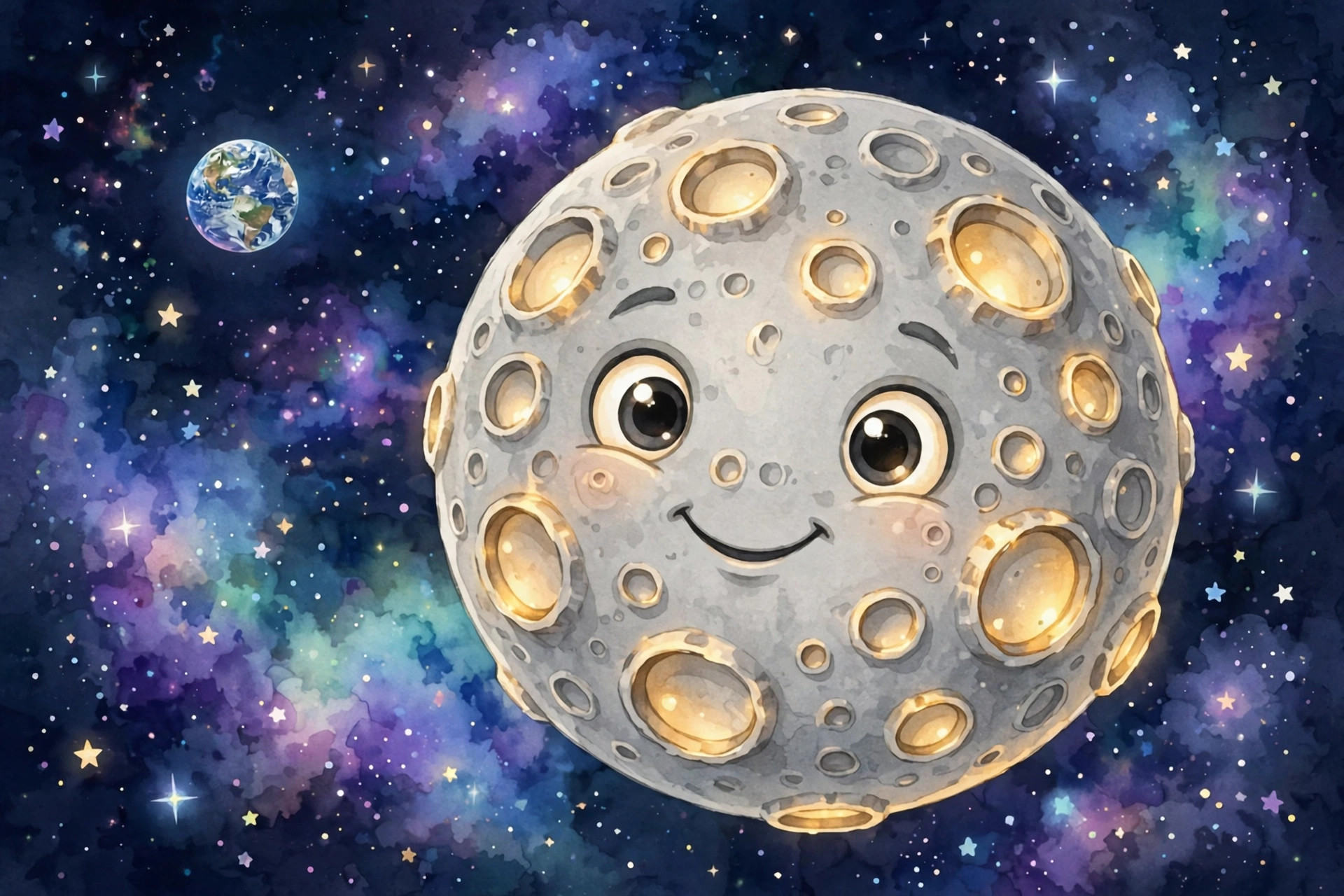
The Moon is a big, rocky ball that travels around Earth. It is not a planet, and it does not make its own light. The Moon shines because it reflects light from the Sun, like a giant mirror in the sky. The side of the Moon that faces the Sun is bright, and the other side is dark.
The Moon is much smaller than Earth. Its diameter is 3,475 kilometres, which is about one quarter of Earth's width. If Earth were a big beach ball, the Moon would be about the size of a tennis ball. Even so, the Moon is very important to us. Its gravity pulls on Earth's oceans and makes the tides — the sea rising and falling on beaches all around the world.
Moon Facts at a Glance
| Diameter | 3,475 km — about one quarter of Earth's width |
|---|---|
| Distance from Earth | 384,400 km on average |
| Time to orbit Earth | 27.3 days for one orbit |
| Full phase cycle | 29.5 days from one new Moon to the next |
| Temperature in sunlight | About 127 °C |
| Temperature in darkness | About −173 °C |
| First person to walk on it | Neil Armstrong, Apollo 11, 20 July 1969 |
| Total Moonwalkers | 12 astronauts, between 1969 and 1972 |
Why Does the Moon Change Shape?
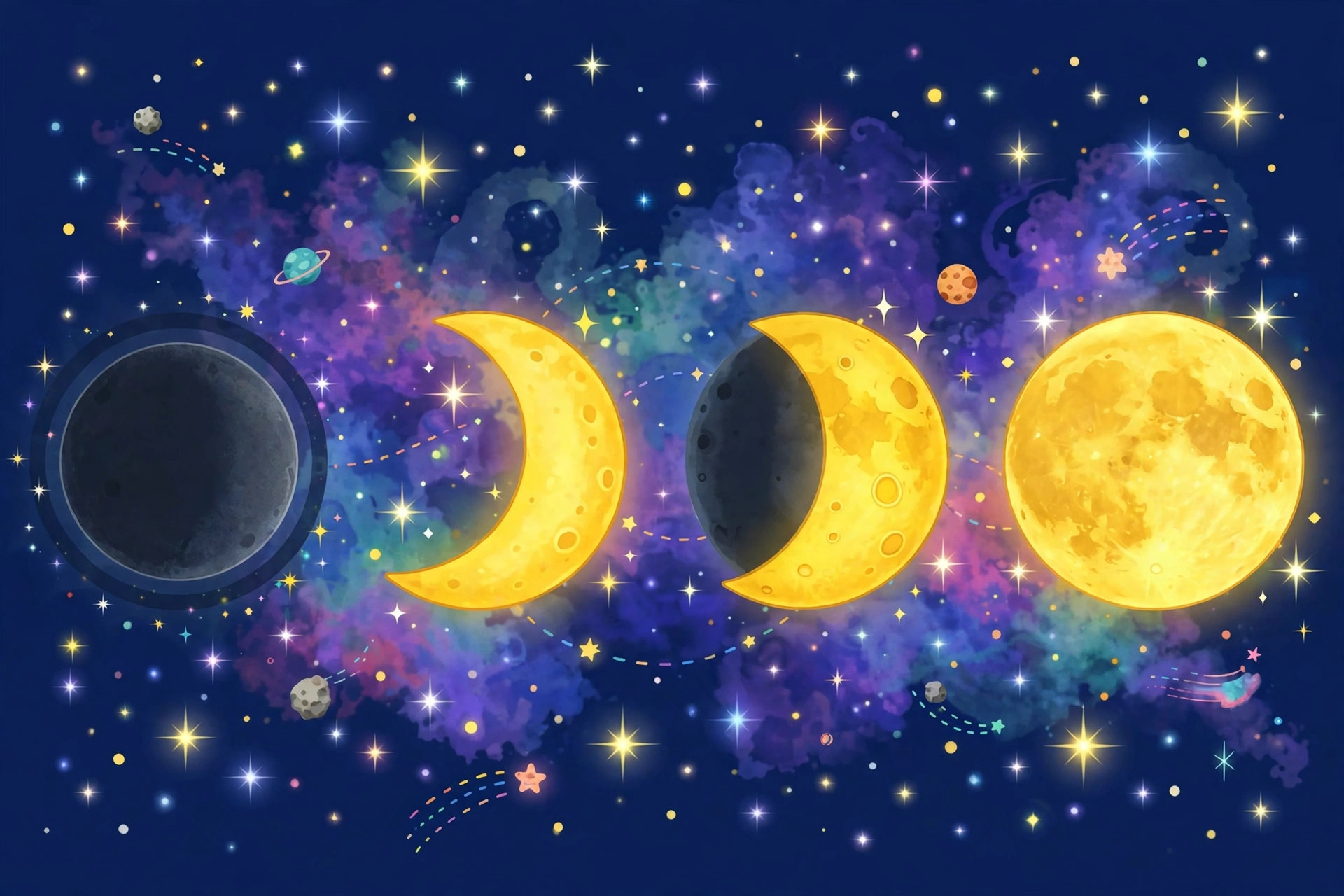
Have you ever noticed that the Moon looks different every night? Sometimes it is a full, bright circle. Sometimes it is only half a circle. Sometimes it is a thin crescent, like a banana. And sometimes you cannot see it at all! These changing shapes are called the phases of the Moon.
Here is the secret: the Moon itself never changes shape. The Sun always lights up half of the Moon. As the Moon travels around Earth, we see a different amount of that lit half. When the lit half faces us fully, we see a full Moon. When the lit half faces away from us, we see a new Moon — the Moon looks dark and hidden. In between, we see crescents, quarters, and gibbous Moons. There are 8 phases in total, and one full cycle takes about 29.5 days.
What Is a Lunar Eclipse?
A lunar eclipse is the one time Earth's shadow really does fall on the Moon. It happens when Earth moves exactly between the Sun and the Moon, and Earth's shadow covers the Moon. During a total lunar eclipse, the Moon can turn a deep red colour. People call it a "blood Moon"! It looks spooky and amazing at the same time.
Lunar eclipses are safe to watch with your own eyes — unlike solar eclipses, where the Moon covers the Sun and you must never look directly at it. If you ever hear that a lunar eclipse is happening, ask a grown-up to help you stay up late and watch it. It is one of the best shows in the whole sky.
Who Walked on the Moon?
On 20 July 1969, something incredible happened. Neil Armstrong, an astronaut from the United States, stepped out of his spacecraft and became the first person ever to walk on the Moon. His mission was called Apollo 11. Buzz Aldrin joined him on the Moon's surface about 20 minutes later, while their friend Michael Collins stayed in orbit above them, flying the spacecraft around the Moon.
Armstrong's first words on the Moon became famous all around the world. Between 1969 and 1972, a total of 12 astronauts walked on the Moon. No human has walked on the Moon since 1972 — but space agencies around the world are planning to send astronauts back in the coming years. Maybe one day, it could be you!
Hot Days and Cold Nights
The Moon is a place of wild extremes. In full sunlight, the Moon's surface heats up to about 127 °C — hotter than boiling water. But in darkness, it drops to about −173 °C, cold enough to freeze almost anything in seconds. The Moon has almost no air to trap heat, so temperatures swing wildly between day and night.
Here is another strange fact: the Moon always shows us the same side. The side we see from Earth is the same side people have always seen, all through history. That is because the Moon spins at exactly the same speed as it orbits Earth. We call this synchronous rotation. The far side of the Moon — sometimes wrongly called the "dark side" — is not dark at all. It gets just as much sunlight as the side we see. We just never get to see it from Earth!
Watch and Learn
Want to learn more about the Moon? Watch these two videos from SciShow Kids. The first explains lunar eclipses, and the second takes you on a tour of space, including our Moon.
Watch: Lunar Eclipses (SciShow Kids)
Watch: Let's Explore Space! | Astronomy for Kids (SciShow Kids)
