Welcome to Space for Kids! 🚀
Are you ready for the biggest adventure ever? Space is full of giant planets, burning stars, glowing clouds where new stars are born, and brave astronauts who fly far above Earth. This site is your rocket to explore it all — one fun fact at a time.
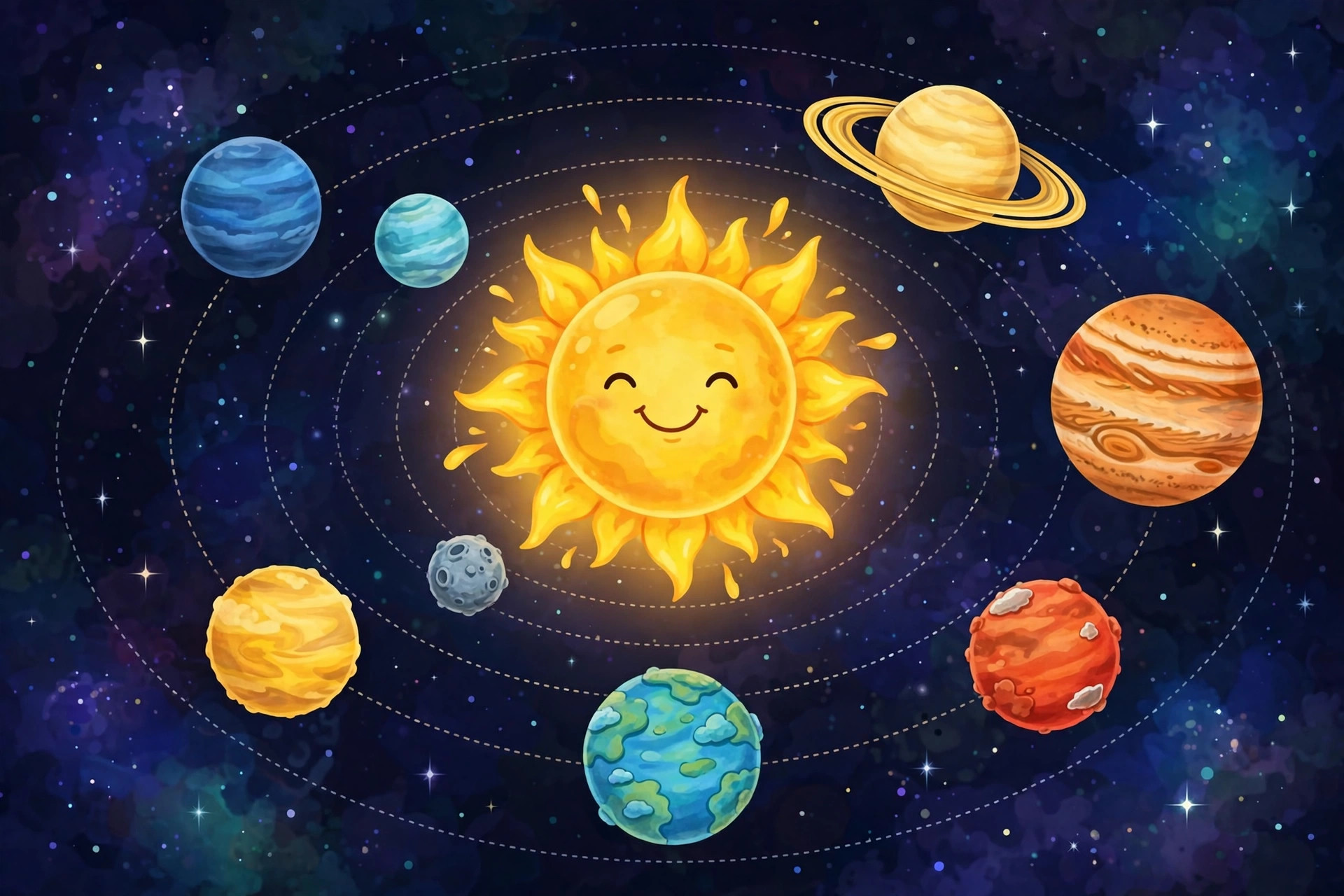
Space is the huge, dark sky that stretches all around our planet Earth. It holds the Sun, the Moon, eight planets, billions of stars, and whole galaxies — giant groups of stars that are so big, our brains can hardly imagine them. The best part? You do not need a rocket to explore space. You just need curiosity, and you are already in the right place.
Every page on this site answers one big question, shares amazing numbers from NASA, and ends with a fun quiz question you can ask your friends or your parents. So buckle up, young explorer. The countdown starts now!
Meet the Solar System
Our home in space is called the solar system. It is made of the Sun and everything that travels around it — eight planets, the Moon, and lots of smaller rocky worlds. Click any card to start your trip!
The Sun
Our star! It is so big that 1.3 million Earths could fit inside it.
🪨Mercury
The smallest planet and the fastest — it zooms around the Sun in only 88 days.
🌕Venus
The hottest planet of all, even hotter than Mercury, which is closer to the Sun.
🌍Earth
Our home! The only place we know that has life — and the only planet with oceans.
🔴Mars
The red planet, home of the biggest volcano in the solar system and brave robot rovers.
🟠Jupiter
The biggest planet of all, about 11 times wider than Earth, with 115 moons.
🪐Saturn
The ringed beauty! Its rings are made of ice and rock, and it would float in water.
🔵Uranus
The sideways planet! It spins on its side, tilted almost all the way over.
💙Neptune
The farthest planet from the Sun — a cold, blue world of wild storms.
🌙The Moon
Earth's best friend in space. Twelve astronauts have walked on it!
✨Stars & Nebulae
Find out how stars are born inside giant glowing clouds called nebulae.
🌌Galaxies & Black Holes
Meet the Milky Way, our home galaxy, and the mysterious black holes.
🚀Rockets & Astronauts
How do rockets fly? Meet the first people in space and the space station crew.
🧠Space Quiz
Think you know space? Take the quiz and test what you have learned!
How Big Is Space?
Space is so big that scientists use a special ruler to measure it: the light-year. A light-year is how far light travels in one whole year. Light is the fastest thing we know, and even light needs years to cross space!
Let's start close to home. The Sun is about 150 million kilometres away from Earth. That sounds far, but sunlight only needs about 8 minutes and 20 seconds to reach us. Now think about this: the Sun is 109 times wider than Earth, and about 1.3 million Earths could fit inside it. It holds 99.86% of all the mass in the whole solar system. Everything else — all eight planets, the Moon, and every asteroid — is just a tiny leftover crumb!
Now step much further out. Our galaxy, the Milky Way, is about 100,000 light-years across. That means light needs 100,000 years to fly from one side to the other! The Milky Way probably holds 100 to 400 billion stars. Our Sun is just one of those billions of stars, sitting near the edge of the spiral, about 28,000 light-years from the centre.
And the Milky Way is only one galaxy among billions and billions of galaxies in the universe. If the whole universe were a beach, each galaxy would be just one grain of sand. Is your mind blown yet? Ours is!
Here is another way to feel how huge space is. The Moon is our closest neighbour in space, and it is 384,400 kilometres away. That sounds close — until you learn that about 30 Earths could fit in the gap between Earth and the Moon! Now imagine the distance to the nearest star after the Sun. It is so far away that even the fastest rocket humans have ever built would need thousands of years to get there. Space is big. Really, really big.
Our Solar System at a Glance
The eight planets are very different from each other. Some are small and rocky, like Mercury and Mars. Others are giant balls of gas, like Jupiter and Saturn. Look at the table below — all these numbers come from NASA, the space agency of the United States.
| Planet | Diameter (km) | Distance from the Sun (million km) | Moons (as of 2026) | Mean temperature |
|---|---|---|---|---|
| Mercury | 4,879 | 57.9 | 0 | 167 °C |
| Venus | 12,104 | 108.2 | 0 | 464 °C |
| Earth | 12,756 | 149.6 | 1 | 15 °C |
| Mars | 6,792 | 228.0 | 2 | −65 °C |
| Jupiter | 142,984 | 778.5 | 115 | −110 °C |
| Saturn | 120,536 | 1,432 | 293 | −140 °C |
| Uranus | 51,118 | 2,867 | 29 | −195 °C |
| Neptune | 49,528 | 4,515 | 16 | −200 °C |
Did you spot something funny? Venus is hotter than Mercury, even though Mercury is closer to the Sun! That is because Venus has a thick blanket of air made mostly of carbon dioxide, and that blanket traps heat like a greenhouse. Mercury has almost no air at all, so its heat escapes into space. Its surface swings from a scorching 430 °C in daylight to a freezing −180 °C at night.
And look at Saturn's moons — 293 of them, as of 2026! Scientists keep finding new moons, so these numbers can change as new ones are confirmed. Jupiter has 115 moons, Uranus has 29, and Neptune has 16. Earth has just one Moon, but what a Moon it is — you can read all about it on our Moon page.
The Sun, the Moon and the Stars
The Sun is not just a bright ball in the sky. It is a star — a yellow dwarf star, to be exact. A star is a ball of shining gas, made mostly of hydrogen and helium, held together by its own gravity. Turning hydrogen into helium creates the energy that makes stars shine. The Sun is about 4.5 billion years old, and it is about halfway through its life. It has about 5 billion more years of shining left!
The Moon is Earth's partner in space. It goes around Earth once every 27.3 days, and it always shows us the same side, because it spins at the same speed as it orbits. The Moon changes shape in the sky — new, crescent, quarter, gibbous, full — but that is not Earth's shadow. The Sun always lights half the Moon, and as the Moon travels around Earth, we see a different amount of the lit half. A full cycle of Moon phases takes about 29.5 days.
Stars come in different colours — white, yellow, red, and blue — and different sizes, from about the size of a planet to many times bigger than the Sun. New stars are born inside nebulae, giant clouds of gas and dust. Gravity pulls a clump of gas together until it gets so hot and dense that it switches on and starts to shine. Every star you see in the night sky was born in a cloud like that, long, long ago.
Rockets and Astronauts
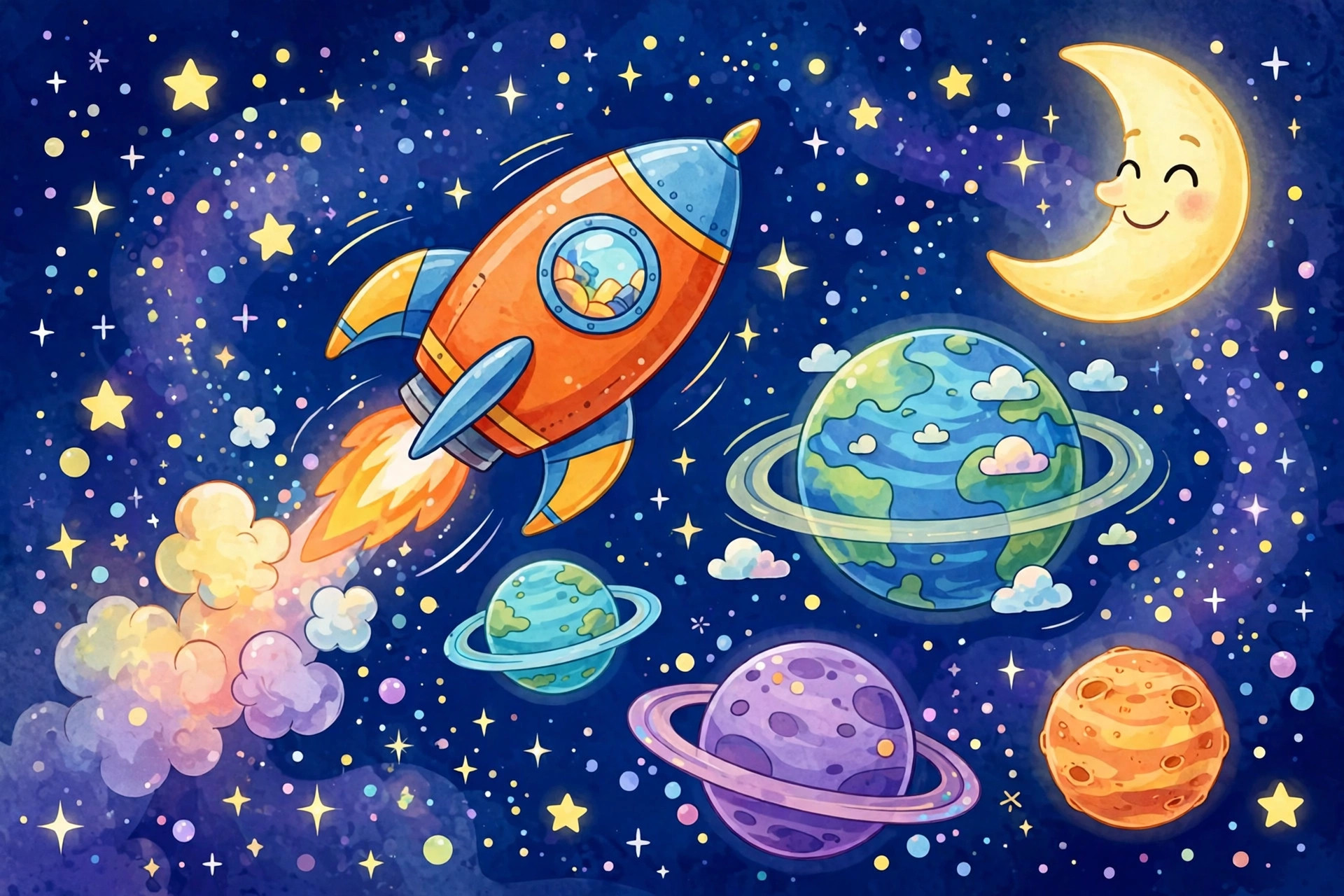
How do humans get into space? With rockets! A rocket works a bit like letting go of a blown-up balloon. The balloon zooms away because air rushes out of the back and pushes it forward. A rocket burns fuel to make hot gas, and the gas escapes through a small opening called a nozzle, pushing the rocket the opposite way. A rocket carries its own oxygen to burn the fuel, so it can fly in space, where there is no air at all.
The first human in space was Yuri Gagarin, from the Soviet Union. On 12 April 1961, he flew one orbit around Earth in a spacecraft called Vostok 1. The flight lasted just 108 minutes, and he travelled at 27,400 kilometres per hour! Eight years later, on 20 July 1969, Neil Armstrong became the first person to walk on the Moon, as part of the Apollo 11 mission. Buzz Aldrin joined him on the Moon's surface, while Michael Collins stayed in orbit above them.
Today, astronauts live and work on the International Space Station, a giant spacecraft that orbits Earth. It flies at 28,000 kilometres per hour, about 400 kilometres above Earth, and it circles our planet every 90 minutes. That means the crew sees 16 sunrises and 16 sunsets every single day! The station is about the size of an American football field, and people have lived aboard it without a break since 2 November 2000.
Watch and Learn
Ready to see the solar system in action? Watch these two great videos — one from National Geographic and one from SciShow Kids — and get a flying tour of our neighbourhood in space.
Watch: Solar System 101 | National Geographic (National Geographic)
Watch: Let's Explore Space! | Astronomy for Kids (SciShow Kids)
Start Exploring
So, young explorer — where will you go first? If you love big numbers and super-hot facts, start with The Sun. If you want a mystery, visit The Moon and learn why it changes shape. If giant planets are your thing, Jupiter and Saturn are waiting for you, rings and all.
When you feel ready, fly out to Stars & Nebulae to see where stars are born, then dive into Galaxies & Black Holes — the strangest places in the universe. And don't miss Rockets & Astronauts, where you will meet the brave people who travel to space for real.
Finally, when you have explored every page, take the Space Quiz and prove you are a true space expert. Good luck — and remember, every astronaut, scientist, and explorer started exactly where you are now: curious, and looking up at the sky.